


Smartphone with Push-to-Talk: 5 Smart Ways to Boost Team Communication & Cut Delays
Smartphone with Push-to-Talk enables instant, reliable communication for industrial teams by boosting coordination and reducing response delays in the field.
Introduction
In an age where communication efficiency defines success, the smartphone with Push-to-Talk (PTT) feature has emerged as a game-changer across industries. Designed for professionals who demand quick, reliable, and secure voice communication, PTT-enabled smartphones bridge the gap between traditional two-way radios and modern mobile technology.
From public safety to construction, logistics, oil and gas, and emergency response — organizations are increasingly shifting toward smartphones with Push-to-Talk functionality to enhance productivity and coordination.
This article explores how PTT smartphones work, their advantages, and why they are becoming essential tools in today’s connected world.
What is a Smartphone with Push-to-Talk?
A smartphone with Push-to-Talk is a mobile device that allows users to communicate instantly with individuals or groups by simply pressing a button. Unlike standard voice calls, which require dialing and connecting, PTT enables near-instant voice transmission — similar to a walkie-talkie — but over cellular or Wi-Fi networks.
Instead of relying on radio frequencies, these smartphones use mobile broadband or Wi-Fi to transmit voice data, ensuring greater coverage and clarity. This means you can talk to team members across cities or even countries without the range limitations of traditional radios.
How Push-to-Talk Works
Push-to-Talk technology operates on the principle of half-duplex communication, meaning only one person can speak at a time while others listen — just like a radio system.
Here’s how the process works:
-
The user presses the PTT button on the smartphone.
-
The voice message is instantly transmitted over a dedicated app or PTT network.
-
Other users in the channel receive the message in real time.
-
Communication continues seamlessly with low latency and clear audio.
Modern smartphones with Push-to-Talk often integrate with software platforms such as Motorola WAVE, Zello, or ESChat, which use secure cloud-based servers for data transmission and encryption.

Benefits of a Smartphone with Push-to-Talk
1. Instant Communication
Speed is one of the most critical advantages. A smartphone with Push-to-Talk enables users to connect with entire teams in seconds — no dialing, ringing, or waiting. This instant communication can significantly improve response times in emergency or time-sensitive situations.
2. Global Coverage
Unlike traditional two-way radios limited by signal range, PTT smartphones use 4G, 5G, or Wi-Fi networks, offering global reach. Whether you’re in a remote field location or an office, as long as you have an internet connection, communication is seamless.
3. Cost-Effective Solution
Many industries are replacing bulky radio systems with smartphones with Push-to-Talk because they reduce infrastructure costs. There’s no need for repeaters, radio towers, or frequency licenses. A single smartphone with a PTT app provides the same functionality — often with more reliability.
4. Multi-Functionality
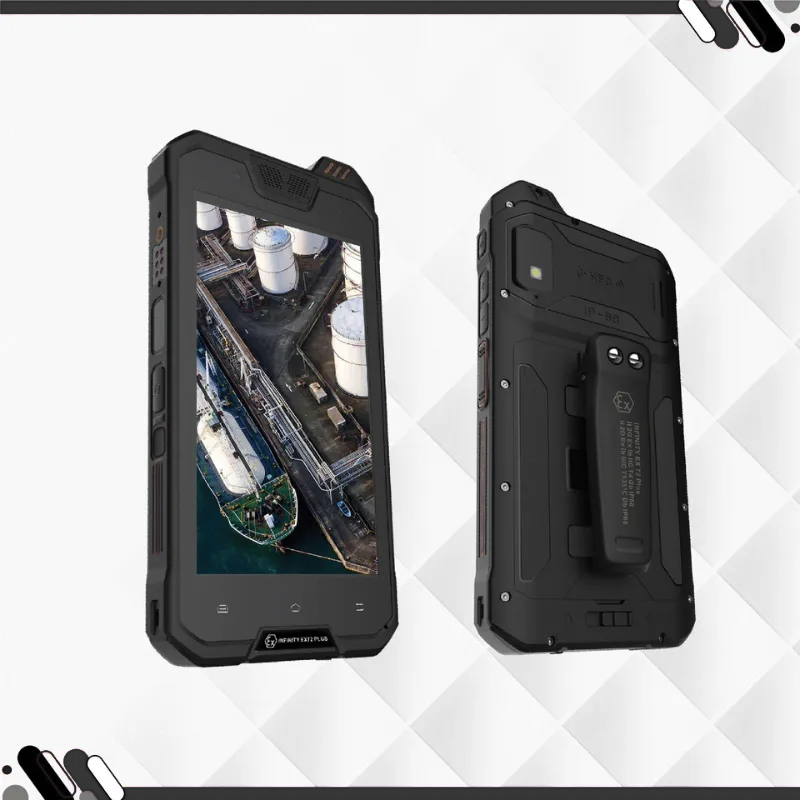
A major advantage is that these smartphones are not limited to communication. They combine radio, camera, GPS, and internet access in one rugged device. This makes them ideal for professionals who need both durability and advanced technology in the field.
5. Enhanced Safety
For workers in hazardous or remote environments, instant communication can be lifesaving. Smartphones with Push-to-Talk allow supervisors to instantly reach staff, coordinate emergency responses, or monitor location via GPS tracking. Many models are also ATEX-certified for use in explosive or high-risk areas.
6. Group Communication
PTT smartphones can connect large teams simultaneously through dedicated channels. Supervisors can create separate talk groups for departments or tasks, ensuring organized communication without interference.
7. Rugged and Durable Design
Most smartphones with Push-to-Talk are built for industrial environments. They often feature IP68 protection, dust and water resistance, and reinforced frames. This durability makes them ideal for industries like construction, transportation, manufacturing, and oil & gas.
Industries That Benefit from Push-to-Talk Smartphones
Public Safety and Security
Police, firefighters, and security personnel rely on real-time voice communication. Smartphones with Push-to-Talk provide instant coordination during operations, ensuring faster decision-making and improved safety.
Construction and Engineering
On large construction sites, quick instructions and team coordination are essential. PTT smartphones eliminate the delays of traditional calls, allowing foremen and site workers to stay connected instantly.
Transportation and Logistics
Fleet managers use smartphones with Push-to-Talk to monitor deliveries, provide route updates, and communicate efficiently with drivers — even across long distances.
Oil, Gas, and Mining
These high-risk environments demand reliable, explosion-proof devices. PTT smartphones with ATEX certifications are designed to operate safely in such hazardous zones while maintaining instant communication.
Event Management
For large-scale events, organizers, security teams, and logistics staff need immediate coordination. Smartphones with Push-to-Talk allow seamless team communication without relying on multiple radios.
Key Features to Look for in a Smartphone with Push-to-Talk
When choosing a smartphone with Push-to-Talk, consider the following essential features:
-
Dedicated PTT Button:
Allows one-touch communication even when wearing gloves or working in the field. -
Rugged Design:
IP67/IP68 rating, drop resistance, and shockproof body. -
Long Battery Life:
Ideal for long shifts or remote work environments. -
Network Compatibility:
4G, 5G, or dual-SIM support for reliable connectivity. -
Loud Speaker and Noise Cancellation:
Clear audio even in noisy industrial environments. -
Push-to-Talk Over Cellular (PoC) Compatibility:
Works with major PoC platforms like WAVE, Zello, and ESChat. -
GPS Tracking and SOS Features:
Enhances worker safety and real-time monitoring.
Smartphones with Push-to-Talk vs Traditional Radios
| Feature | Smartphone with Push-to-Talk | Two-Way Radio |
|---|---|---|
| Range | Global (via 4G/5G/Wi-Fi) | Limited to local signal area |
| Features | Voice, GPS, camera, apps | Voice only |
| Cost | Low infrastructure cost | Requires license and repeaters |
| Durability | Rugged, water/dust resistant | Rugged but less versatile |
| Scalability | Unlimited users | Limited channels |
| Security | Encrypted communication | Often unencrypted |
This comparison clearly shows that a smartphone with Push-to-Talk not only replaces traditional radios but also enhances team productivity and communication efficiency.
Push-to-Talk Apps and Software Platforms
There are several popular platforms that support Push-to-Talk communication on smartphones:
-
Motorola WAVE PTX – Secure cloud-based PTT for enterprise use
-
Zello – Widely used app for instant voice communication
-
ESChat – Military-grade encryption and network reliability
-
Kodiak PTT+ – Carrier-integrated service for large organizations
-
Broadnet PTT – High-quality PoC communication system
Each app offers unique advantages depending on the organization’s size, security needs, and infrastructure.
Why Choose a Smartphone with Push-to-Talk for Your Business
Adopting a smartphone with Push-to-Talk can streamline your business operations in several ways:
-
Improved team collaboration
-
Faster emergency response
-
Reduced communication costs
-
Higher reliability in remote or industrial areas
-
Integration with existing enterprise systems
For businesses operating in critical industries like oil & gas, logistics, and construction, these benefits directly translate to improved safety, efficiency, and profitability.
The Future of Push-to-Talk Technology
The evolution of Push-to-Talk is moving toward 5G and AI-powered communication. Future smartphones will support:
-
Real-time translation during PTT communication
-
AI-based voice recognition for command automation
-
Edge computing for faster data processing
-
Integration with wearable safety devices
As industries become more connected, smartphones with Push-to-Talk will continue to replace traditional radios, offering scalable and secure solutions for enterprise communication.
Conclusion
The smartphone with Push-to-Talk is transforming how teams communicate in mission-critical industries. It delivers instant connectivity, rugged reliability, and advanced safety features in one device.
Whether used in construction, logistics, or hazardous industrial environments, PTT smartphones provide the speed and efficiency modern organizations require. By adopting this technology, companies can improve workflow, enhance team safety, and ensure that communication never stops — no matter where the job takes them.
Related ATEX Products & Resources
Explore our range of ATEX-certified devices for hazardous areas: