


UL Certification: 5 Essential Safeguards for Product Safety & Compliance
UL Certification ensures product safety and regulatory compliance by meeting strict testing standards and reducing operational and legal risks.
Introduction
In industries where safety and reliability are paramount, certification plays a crucial role. One of the most recognized and respected safety marks worldwide is UL Certification.
UL (Underwriters Laboratories) is a global safety certification company that evaluates, tests, and certifies products to ensure they meet strict safety, performance, and regulatory standards. For industrial environments—especially those involving electrical or explosion-proof equipment—UL Certification is a symbol of trust, safety, and compliance.
This article explains what UL Certification is, why it’s important, how it works, and how it benefits both manufacturers and end-users in hazardous and non hazardous industries.
What Is UL Certification?
UL Certification is a safety compliance mark issued by Underwriters Laboratories, a U.S.-based independent safety science organization founded in 1894.
A UL-certified product has been thoroughly tested and meets specific safety, fire, and electrical standards. The certification is recognized globally and often required by manufacturers, distributors, and regulatory authorities before a product can enter the market.

Purpose of UL Certification
The primary purpose of UL Certification is to:
-
Ensure product safety and reduce hazards like fire, electric shock, or explosion.
-
Verify that a product meets industry-specific safety requirements.
-
Build consumer confidence through third-party validation.
-
Support compliance with national and international standards (such as OSHA or ANSI).
How UL Certification Works
The process of achieving UL Certification involves several stages, including testing, factory inspections, and ongoing compliance checks.
1. Application and Product Submission
Manufacturers submit product samples and technical documentation to UL for review.
2. Testing and Evaluation
UL engineers test the product against applicable safety standards. Tests may include:
-
Electrical insulation performance
-
Temperature rise and thermal stability
-
Fire and flammability resistance
-
Explosion protection (for hazardous-area equipment)
3. Factory Inspection
UL inspects manufacturing facilities to ensure consistent quality control.
4. Certification and Marking
If the product passes all requirements, it receives the UL Mark, which indicates compliance.
5. Continuous Auditing
UL performs periodic audits to ensure ongoing compliance and production consistency.
Types of UL Marks
UL offers different certification marks depending on the region and product type.
| UL Mark | Meaning |
|---|---|
| UL Listed | Product has been tested and meets safety standards for the U.S. market. |
| cUL Listed | Product meets Canadian safety standards. |
| UL Recognized Component | Applies to components used within a larger certified product. |
| UL Classified | Product tested for specific hazards or performance claims. |
| cULus Mark | Certified for both U.S. and Canadian markets. |
UL Certification vs. CE, ATEX, and ATEX
It’s common to confuse UL Certification with other international safety marks. Here’s how they differ:
| Certification | Region | Focus |
|---|---|---|
| UL | USA / North America | Electrical safety, fire, and explosion protection |
| CE | Europe | Product conformity to EU directives |
| ATEX | Europe | Explosion protection in hazardous atmospheres |
| ATEX | Global | Electrical safety for explosive environments |
While ATEX and ATEX are specific to hazardous areas, UL Certification is broader—covering everything from electrical appliances to industrial control panels and explosion-proof devices.
Importance of UL Certification in Hazardous Areas
In industries dealing with flammable gases, dust, or chemicals, the smallest spark can lead to catastrophic explosions. UL provides certification standards for explosion-proof (Ex) equipment, ensuring they are safe for use in such environments.
UL evaluates:
-
Enclosure strength (to withstand internal explosions)
-
Temperature ratings (to prevent ignition)
-
Ingress protection (IP) for dust and moisture
-
Electrical circuit designs (for intrinsic safety)
Manufacturers of ATEX and IECEx-certified devices often pursue UL Certification as well to enter the North American market.
UL Certification Process for Explosion-Proof Equipment
-
Product Testing: UL verifies explosion-proof design, materials, and electrical limits.
-
Hazardous Location Assessment: Equipment is classified according to Class, Division, or Zone systems.
-
Documentation Review: Design drawings, safety reports, and material specifications are analyzed.
-
Field Evaluation: UL auditors inspect production lines and random samples.
-
Approval and Labeling: Once approved, the device is allowed to bear the UL Explosion-Proof Mark.
UL Hazardous Location Classifications
In North America, hazardous locations are divided into Classes, Divisions, and Zones, similar to ATEX’s Zone 0/1/2 system.
| Class | Type of Hazard |
|---|---|
| Class I | Flammable gases or vapors (e.g., oil & gas plants) |
| Class II | Combustible dusts (e.g., grain handling, flour mills) |
| Class III | Fibers and flyings (e.g., textile or wood industries) |
Each class is further divided into:
-
Division 1: Hazard normally present
-
Division 2: Hazard present only under abnormal conditions
UL ensures that devices meet specific criteria for these classifications.
Benefits of UL Certification
1. Market Acceptance
UL is widely recognized in the U.S., Canada, and globally, increasing product credibility.
2. Legal Compliance
Many industries, including construction and oil & gas, require UL-certified equipment to meet OSHA and NFPA codes.
3. Risk Reduction
UL-certified devices minimize the risk of fire, shock, or explosion, ensuring worker safety.
4. Competitive Advantage
UL Certification differentiates products from competitors lacking formal safety validation.
5. Brand Trust
Customers are more likely to choose UL-certified products because they symbolize quality, reliability, and compliance.
Industries That Rely on UL Certification
| Industry | Use Case |
|---|---|
| Oil & Gas | Explosion-proof lighting, control panels, and communication devices |
| Chemical Plants | ATEX & UL dual-certified monitoring systems |
| Construction | Electrical panels and power tools |
| Automotive | EV batteries, charging systems |
| Manufacturing | Industrial automation and robotics |
| Electronics | Consumer devices, chargers, cables |
How to Verify UL Certification
To verify whether a product is genuinely UL certified:
-
Look for the UL Mark on the product or label.
-
Check the UL Product iQ Database online.
-
Verify the manufacturer’s name and certification number.
-
Ensure that the mark matches your region (e.g., cULus for North America).
UL Certification for Manufacturers
Manufacturers seeking UL Certification must:
-
Submit product samples for independent testing.
-
Pass initial and unannounced factory inspections.
-
Maintain consistent quality in production.
-
Update UL with design changes before releasing new versions.
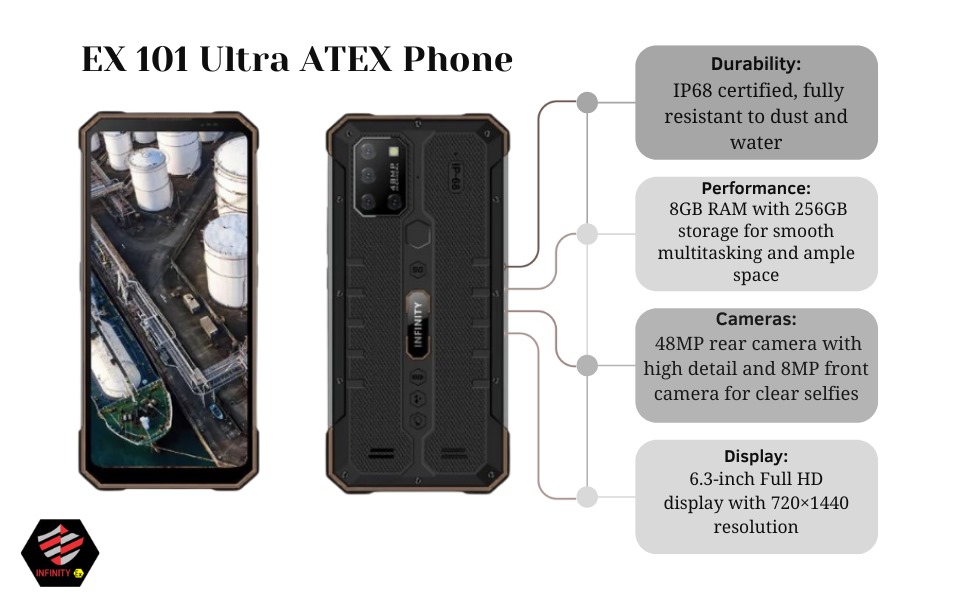
UL Certification for Explosion-Proof Phones and Tablets
For companies like Infinity Ex, which develop explosion-proof mobile phones and tablets,
-
The devices are safe for Class I, Division 2 or Zone 2 areas.
-
Compliance with UL 913 (Standard for Intrinsically Safe Equipment).
-
Compatibility with ATEX requirements for global deployment.
Having UL Certification allows such devices to be sold in both European and North American markets, broadening commercial reach.
UL Certification and Sustainability
UL also focuses on environmental responsibility. It offers certifications like:
-
UL Environment (ULE) for eco-friendly materials
-
UL Energy Verification for energy-efficient products
-
UL Greenguard for low chemical emissions
These initiatives promote sustainability in manufacturing while maintaining safety standards.
Challenges in Getting UL Certified
-
Time-Consuming Process – Testing and documentation can take several months.
-
High Costs – Certification fees are significant for startups.
-
Frequent Audits – Ongoing compliance checks can be demanding.
-
Design Modifications – Products may need redesigning to meet UL criteria.
Conclusion
UL Certification is more than just a mark — it’s a global standard of safety, quality, and trust.
For industries dealing with hazardous environments, UL ensures that every device, from explosion-proof phones to control panels, meets the highest safety standards.
In a world driven by technology and automation, UL remains a cornerstone of industrial reliability and compliance.
Whether you’re a manufacturer, distributor, or end-user, choosing UL-certified products means choosing safety first.
FAQs
1. What does UL Certification mean?
It verifies that a product meets U.S. safety standards for electrical and fire protection.
2. Who issues UL Certification?
It’s issued by Underwriters Laboratories, an independent global safety organization.
3. Is UL Certifications mandatory?
Not always, but many industries and markets require it for product approval.
4. How is UL different from CE?
UL is recognized in North America, while CE applies to the European Union.
5. Can a product have both UL and ATEX Certification?
Yes, especially if it’s sold in both North American and European markets.
6. How long does UL Certification take?
Typically 2–6 months depending on product complexity.
7. What is the cost of UL Certification?
It can range from $5,000 to $50,000 based on testing requirements.
8. Does UL Certification expire?
It remains valid as long as the manufacturer maintains compliance and passes audits.
9. How do I verify if a product is UL Certified?
Search the UL Product iQ Database using the certification number.
10. Is UL recognized worldwide?
Yes, UL is respected globally, especially in North America, Asia, and Europe.
11. What products need UL Certification?
Electrical equipment, control panels, lighting systems, and explosion-proof devices.
12. What is UL 913?
A standard for intrinsically safe electrical equipment used in hazardous locations.
13. Can companies outside the U.S. apply for UL Certifiy?
Yes, UL operates globally and accepts international manufacturers.
14. Does UL Certifications guarantee quality?
It guarantees safety and performance standards but not design preference.
15. Why is Certification important in hazardous industries?
It ensures that equipment won’t ignite gases or dust, protecting both workers and assets.
Related ATEX Products & Resources
Explore our range of ATEX-certified devices for hazardous areas: